
What is an opioid settlement?
Nationally, the combined amount of opioid settlements so far is more than $50 billion. That amount could go up even more in the coming years as more settlements are reached. The formula for distributing these funds to states is complex and depends on population, overdose risk, and opioid prescribing patterns. You can use this page to learn more about how the settlement works in Rhode Island. You can also see where funds have been spent and learn more about how to get involved.
Rhode Island has a statewide plan
Settlements are funding statewide programs in overdose prevention, treatment, recovery, and harm reduction.
We are using the State’s existing Governor’s Overdose Task Force Action Plan as a roadmap to recommend the distribution of these funds throughout the state. We have already utilized this plan to guide millions of dollars in statewide overdose prevention and substance use treatment investments. The Action Plan is also helping us make sure that funds are equitably distributed, taking into consideration the history of structural racism and its impact on health. Our roadmap for distributing funds is guided by principles developed by Johns Hopkins University. This recommendation process is overseen by state, municipal, and community representatives. The group is called the Opioid Settlement Advisory Committee (OSAC).
How does the settlement process work?
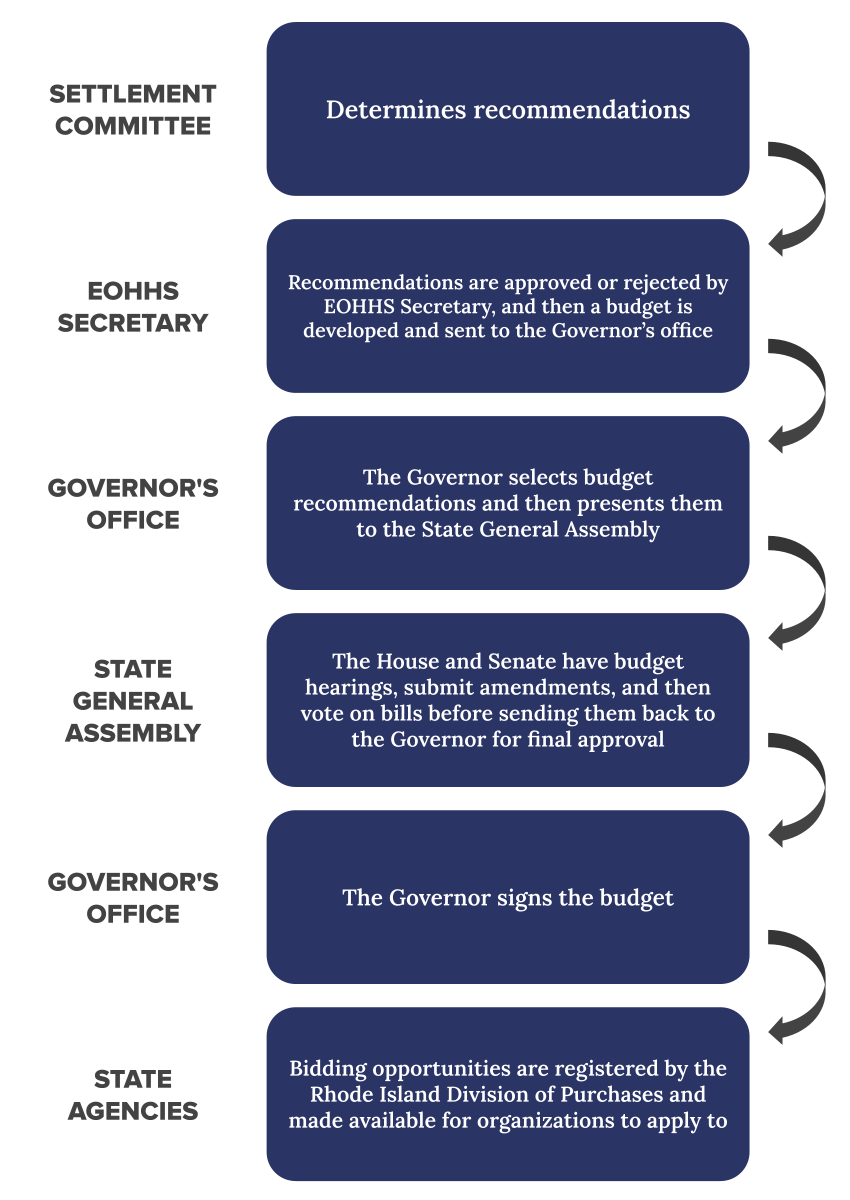
The OSAC first convened in April 2022. Each year, OSAC recommends areas to focus on and approves a funding budget drafted for them by State staff. Next, they present the budget to the Secretary of the Rhode Island Executive Office of Health and Human Services (EOHHS). The Secretary can accept the budget or talk with OSAC to make changes to it. Lastly, the Secretary presents the final budget to the Governor. The Governor puts it in their budget to be considered by the General Assembly. You can learn more about the settlement process here.
In Rhode Island, 80% of all settlement funds follow this process. The other 20% is distributed to our cities and towns based on another formula. Learn more about the settlement process for cities and towns in Rhode Island.
If you are an organization looking to bid on open procurement opportunities, the EOHHS has put together resources and guidance for the bidding and solicitation process. There are also other ways to get involved in the procurement process.
How is the State allocating settlement funds?
Settlement funds have already been allocated to fund projects like addressing social determinants of health such as basic needs and housing, as well as evidence-based prevention programs in schools, mental health and treatment services, harm reduction programs, and recovery supports. The chart below shows how funding allocations change over time. Further below, you can learn more about specific programs being funded.
What types of programs are being funded?
Rhode Island is looking across the continuum of care to improve the health and well-being of people affected by the overdose crisis. On September 25, 2025, the Rhode Island Foundation, in partnership with the Governor’s Overdose Task Force, announced that it has awarded $2.5 million in grants to support 19 nonprofits on the front lines of addressing the state’s overdose crisis. The grants were awarded in three categories: Basic Needs Support, Family Support, and Trauma Support.
Most of the settlement funds fall under these statewide effort areas. Click each section to learn more:
Social Determinants of Health & Prevention

Settlement funds are going to programs that can reduce the risk of overdose by supporting people as early as possible, including:
- Providing basic needs supports, such as food, tents, and sleeping bags
- Providing transportation to treatment or recovery programs or services
- Providing services tailored to disproportionately impacted communities including the Medical Respite Care Program for people experiencing housing insecurity or houselessness
- Expanding Street Medicine Outreach services, which include providing mobile wound care
- Wrap-around and community services like housing, transportation, education, job placement, job training, or childcare, including Progreso Latino’s Comprehensive Family Support Initiative, which will connect people to bilingual peer and family support groups, social services, youth mentorship, wellness activities and educational opportunities
- Funding evidence-based school and community education programs including Rhode Island Student Assistance Services (RISAS)
- Supporting greater access to community-based mental health services and supports for young people, including the Substance Use and Mental Health Leadership Council of RI (Youth Pride)
Rescue & Harm Reduction

Funding for Rescue and Harm Reduction focuses on using tools to help people be safer when using drugs, including:
- Supporting harm reduction services and other evidence-informed harm reduction programs, including Rhode Island’s first Overdose Prevention Center
- Centralized distribution center of naloxone for community-based organizations and community members. URI’s Community First Responder Program (CFRP) is continuing to distribute Naloxone kits throughout Rhode Island
- Education and training for individuals and organizations on naloxone and other drugs treating overdoses
- Maximizing access to harm reduction resources by investing in community outreach organizations. Harm Reduction Vending Machines are available across the state that provide free drug-use health supplies
- Connecting individuals to treatment or other services following an opioid overdose. Rhode Island Hospital is partnering with local organizations to launch a post-overdose engagement program. This provides a same-day support or treatment services
- Expanding mobile outreach efforts in BIPOC communities. Additional locations and times are available through mobile outreach, including evening and weekend programs
Treatment

Settlement funds are helping ensure that anyone who is interested in treatment can get help. Funding currently supports:
- Increasing low-barrier access to Medications for Opioid Use Disorder (MOUD)
- Increasing the availability of treatment beds. Plans include building new facilities and renovating existing SUD residential treatment facilities to increase bed size and improve the quality of care
- Increasing gender specific youth treatment as well as family therapists in treatment centers
- Development of treatment programs focused on stimulant use disorder
- Providing support for individuals receiving care at Opioid Treatment Programs (OTPS) or detox who are uninsured or underinsured
Recovery

Settlement funds ensure recovery from substance use disorder is possible for everyone. Funding is supporting:
- Recovery Community Centers that provide recovery services and peer-recovery for individuals with opioid use disorder
- Access to recovery housing for individuals with opioid use disorder and any co-occurring conditions, by building more recovery communities
- Job training or educational services for individuals in treatment or recovery
- Families affected by substance use disorder
- Recovery Friendly Workplaces (RFW). This initiative provides training, policy guidance, and leadership engagement to support mental health, substance use recovery, and overall employee well-being. In 2025, 50 new certified workplaces were added to the RFW program.
- Supporting the recovery community within building, construction, and trades council members, with a focus on BIPOC industry workers. Building Futures provides recovery resources to to offer help and resources to building trades members and contractors
- Investments in community-based mental health services and the recruitment, support, and training of Peer Recovery Specialists, including through 2nd Act’s Rhode Island Peer Support Alliance initiative
Opioid Stewardship Fund
In 2019, Rhode Island established the Opioid Stewardship Act. It creates a program to address the opioid overdose crisis. This program sets aside money to be used for treatment, recovery, prevention, and education services.
There is an annual “tax” (otherwise known as an assessment) on all opioid products sold or distributed in Rhode Island. Based on this assessment, there is a fee paid by companies involved in the sale and distribution of opioids within the state. Patients do not pay this fee. There is a cap on the annual fee, typically around $5 million.
The money is placed into an account called the Opioid Stewardship Fund. It can only be used for projects directly related to opioid overdose prevention. EOHHS oversees the distribution of funds to align with the state’s overdose prevention efforts.
Opioid Settlement and Opioid Stewardship Act Annual Reports
The reports below show how funds were disbursed each year.